

Health advisory
- Status:
- Active
- Advisory number:
- 20260420
- Date issued:
- 20 Apr 2026
- Issued by:
- Dr Caroline McElnay, Chief Health Officer
- Issued to:
- Health professionals and consumers
Key messages
- Poisonous mushrooms including the death cap and yellow-staining mushrooms, appear in Victoria during autumn, as the weather becomes wetter and cooler.
- Consuming even a single death cap mushroom may result in death.
- Cooking, peeling or drying these mushrooms does not remove or inactivate the poison.
- There is no home test available to distinguish safe and edible mushrooms from poisonous mushrooms.
- Mushrooms purchased from a supermarket, greengrocer or other reputable source are safe to eat.
- Do not pick and eat wild mushrooms in Victoria, including from your home garden, unless you are an expert.
- Remove any mushrooms growing in home gardens that you’re unsure about as young children and pets can easily eat them.
- If you suspect you or anyone in your care may have eaten a poisonous mushroom, do not wait for symptoms to occur. Call the Victorian Poisons Centre immediately on 13 11 26 (24 hours a day, 7 days a week, Australia wide) for appropriate advice.
What is the issue?
Death cap mushrooms
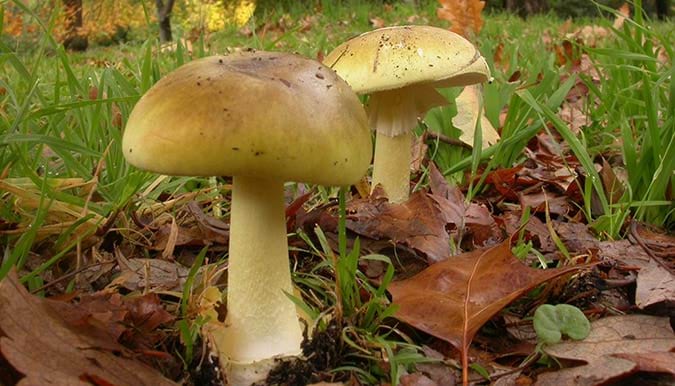
Courtesy of Royal Botanic Gardens Victoria, photographer Tom May.
Death cap mushrooms (Amanita phalloides) are extremely poisonous. Consuming just one mushroom can kill an adult. Symptoms usually commence 6 to 24 hours after ingestion with stomach pains, nausea, vomiting and diarrhoea. These symptoms can then settle, giving a false sense of recovery, however the toxin will have entered the body’s circulation and started causing serious harm, particularly to the liver. Typically, 2 to 4 days after ingestion those severely poisoned will develop irreversible liver failure, often associated with kidney failure, that may ultimately result in death.
These mushrooms usually grow under oak trees and the caps are 40-160 mm in diameter. The cap ranges in colour from pale yellow to green and olive brown, and the ridges on the underside of the cap (gills) are white. The base of the stem has a membrane ‘cup’.
Yellow-staining mushrooms
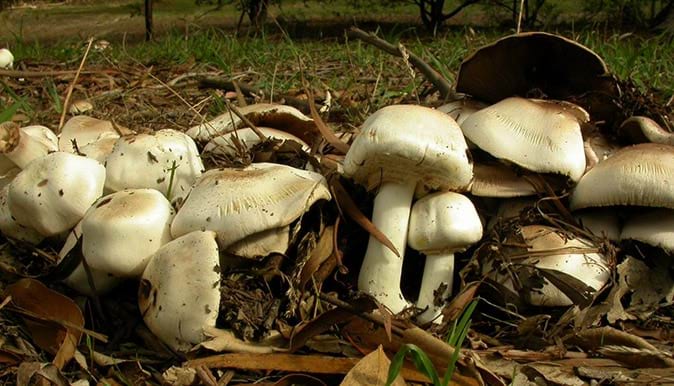
Courtesy of Royal Botanic Gardens Victoria, photographer Tom May.
The yellow-staining mushroom (Agaricus xanthodermus) is the cause of most poisonings due to ingestion of wild fungi in Victoria. Symptoms of yellow-staining mushroom poisoning include stomach pain, nausea, vomiting and diarrhoea. The severity of symptoms varies with the amount eaten.
This mushroom looks very similar to regular purchased mushrooms or ‘cultivated mushrooms’ (Agaricus bisporus) and to edible wild mushrooms such as the field mushroom (Agaricus campestris). In urban areas the yellow-staining mushroom is unfortunately much more common than edible mushrooms. It can grow in large troops in lawns and gardens, and when damaged, the cap and stem stain yellow, later fading to a brownish colour. The mushroom can also emit a chemical like smell.
Who is at risk?
Anyone who collects and consumes wild mushrooms of unknown species is putting themselves at risk of potential poisoning and serious illness. Consuming a death cap mushroom may result in death.
Children should not touch wild mushrooms with their bare hands and animals should be kept away from them.
Pets can develop a range of illnesses from eating wild mushrooms including gastroenteritis-type syndrome to severe life-threatening disease and death. Dogs are more likely than cats to ingest mushrooms.
Recommendations
Unless you are an expert, do not pick and eat wild mushrooms in Victoria, including from your home garden.
If you suspect you or anyone in your care may have eaten a poisonous mushroom, do not wait for symptoms to occur before seeking medical attention.
Contact the Victorian Poisons Centre immediately on 13 11 26 (24 hours a day, 7 days a week, Australia wide) for appropriate advice. This may include seeking treatment at a hospital emergency department. Keep a sample and a photograph of the mushroom that was consumed to share with the Victorian Poisons Centre for expert identification of the mushroom.
If you or anyone in your care feels unwell after eating wild mushrooms, including with severe gastrointestinal symptoms, immediately call 000 for an ambulance. Do not call the Victorian Poisons Centre in an emergency.
Pet owners should take particular care in areas where mushrooms may grow.
Wear gloves when removing mushrooms growing in the home garden. Place the mushrooms carefully in a bag and dispose of them in a closed general waste (landfill) rubbish bin.
Updated